

How to Style Oversized Streetwear: 2026 Fit Guide
Table of Contents
- Why Oversized Streetwear Still Dominates in 2026
- The Best Oversized T-Shirt Fit Guide: Shoulder, Sleeve, and Length
- How to Layer Oversized Clothing Without Looking Bulky
- Oversized Streetwear Outfit Ideas for Men (2026)
- Balancing Proportions: Structured Bottoms, Footwear, and Accessories
- Body Type, Thrifted Finds, and Seasonal Transitions
- Fabric Care: Making Oversized Streetwear Last
- Frequently Asked Questions
Last Updated: September 10, 2026
Why Oversized Streetwear Still Dominates in 2026
Oversized streetwear is the deliberate use of garments cut with extra room through the chest, shoulders, and body for a relaxed, bold silhouette rather than a snug one. This guide from Unmatched Apparel breaks down how to style oversized streetwear so the fit reads intentional, not accidental.
The look holds its ground because it solves a real problem: it works in the gym, on the street, and at dinner without a costume change. Get the proportions right and one outfit does all three; get them wrong and you look like you borrowed someone else's clothes.
Below are the exact fit rules, layering methods, and outfit formulas that make oversized pieces look sharp, starting with what "oversized" should actually measure.
The Best Oversized T-Shirt Fit Guide: Shoulder, Sleeve, and Length
An oversized t-shirt fits correctly when the shoulder seam sits just past your natural shoulder line, the sleeve ends mid-to-lower bicep, and the hem lands between mid-fly and upper thigh (masterclass.com). Anything beyond those marks tips from oversized into ill-fitting.
Here's how to check each zone:
- Shoulder: Seam should drop roughly 1-2 inches past your natural shoulder point. More than that and the shirt swallows your frame.
- Sleeve: Should hit mid-bicep to just above the elbow. A sleeve that reaches your elbow adds bulk you don't want.
- Length: Hem should fall between the middle of your fly and the upper thigh. Longer than that and you're into dress territory.
- Body width: You should be able to pinch 2-3 inches of fabric at each side seam without the shirt looking painted on.
A common mistake is sizing up twice to chase the look. One size up from your true fit is almost always enough. Two sizes up is where "oversized" turns into "tent."
The 3-3-3 Rule for Oversized Proportions
The 3-3-3 Rule is a simple proportion check: one oversized piece per outfit, no more than three inches of extra fabric at any single seam, and three points of structure (shoulders, waist, or ankles) visible. It's a fast way to test an outfit before you leave the house.
Break it and the outfit collapses into shapelessness. Follow it and oversized reads as a choice. If your top is boxy, your bottoms and footwear should carry the structure.
How to Layer Oversized Clothing Without Looking Bulky
Layering oversized clothing works when each layer gets progressively shorter and lighter than the one beneath it. The outer layer should be the shortest and thinnest, keeping the silhouette from stacking into a wall of fabric.
Try this order for cold-weather fits:
- Thermal base layer: A fitted thermal base layer sits closest to the skin and adds warmth without width.
- Oversized tee or knit: This is your statement layer. Keep it the roomiest piece in the stack.
- Short jacket or overshirt: A cropped bomber or boxy overshirt that ends at the hip locks the proportions in place.
- Structured bottom: Wide-leg trousers or straight denim ground the whole look.
Fabric weight matters more than layer count: two heavy layers bulk you up faster than three light ones. Reach for a fitted thermal base and a midweight knit before adding a third heavy piece.
Oversized Streetwear Outfit Ideas for Men (2026)
Most outfit lists hand you a vibe and stop there. These five formulas give you the garment specs, proportion logic, and trade-offs, so you can build each look from pieces you own or know exactly what to buy.
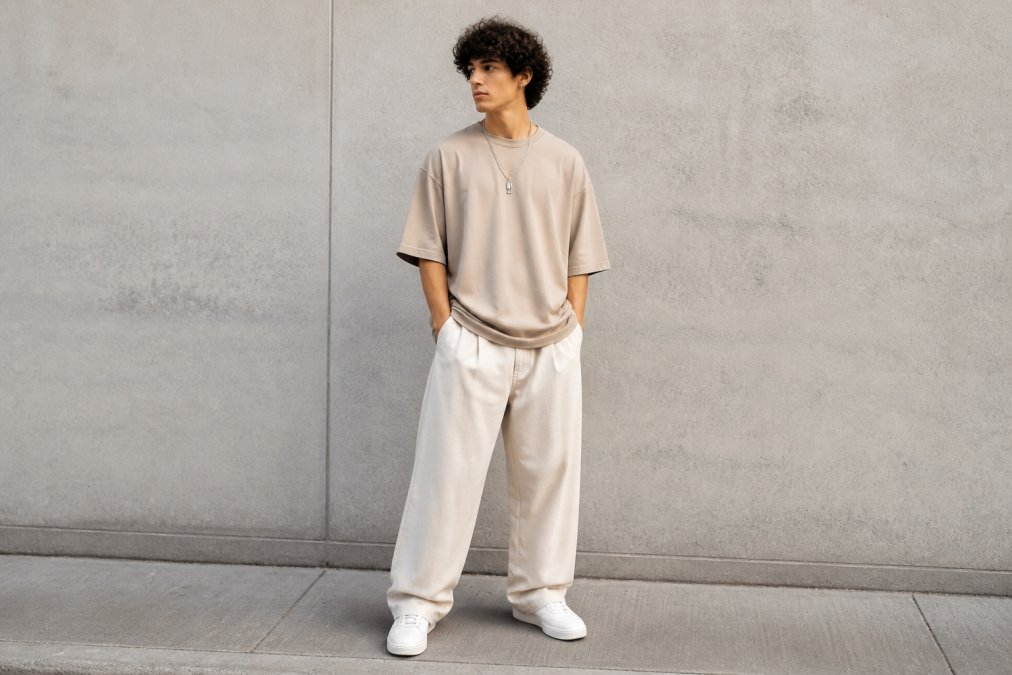
1. The gym-to-street fit. An oversized tee (one size up, hem at mid-fly) over fitted joggers or tapered sweatpants, finished with clean low-profile sneakers. The fitted bottom does the balancing, so the top can stay roomy. The trade-off: a strong cuff makes the top look boxier, so keep the cuff relaxed rather than elastic-tight. This fit transitions straight from training to errands.
2. The neutral city fit. An oversized boxy tee in a neutral tone (bone, oatmeal, washed black, or slate), wide-leg trousers with a 9-to-10-inch leg opening, and a single chain or watch. Neutral tones let you build a capsule wardrobe around four or five pieces that all work together. The mechanism: a near-monochrome palette removes color contrast, so the silhouette contrast between roomy top and structured bottom becomes the focal point.
3. The layered cold-weather fit. A fitted thermal base layer, an oversized midweight knit, and a short jacket that ends at the hip, with straight denim below. The short jacket keeps the outer silhouette from ballooning. Watch the sleeve stack: if the knit sleeve extends past the jacket cuff by more than an inch or two, roll the knit cuff once so the jacket reads as the outer layer.
4. The elevated monochrome fit. An oversized long-sleeve tee or lightweight crewneck in the same color family as your trousers, French-tucked at the front only, plus a low-profile leather sneaker or Chelsea boot. The single-color approach stretches your vertical line, counteracting the widening effect of the oversized top. This formula reads most "styled" and least "borrowed."
5. The transitional-weather fit. An oversized tee under an open button-down overshirt or flannel, with straight-leg denim and a chunky sneaker. Wearing the overshirt open creates two vertical lines down your torso that visually narrow the oversized tee underneath. When the temperature drops, button the overshirt and swap the tee for a fitted long-sleeve base.
What separates these from generic styling advice is the structure underneath: every oversized top is paired with a bottom that holds a line, and every formula names the mechanism (vertical lines, monochrome stretch, cuff control) that keeps the fit from collapsing into shapelessness.
Balancing Proportions: Structured Bottoms, Footwear, and Accessories
Outfit balance comes down to contrast: the looser your top, the more structure your bottom, footwear, and accessories need to carry. Skip it and the look reads baggy rather than styled.
Structured bottoms are your anchor. Wide-leg trousers, straight denim, and tailored cargos hold a clean line from hip to ankle, keeping the oversized top from dragging your silhouette down. Baggy-on-baggy can work, but it demands confidence and the right drape, and it fails more often than it lands.
Footwear sets the tone. Chunky sneakers echo the volume of an oversized fit and root it in sneaker culture; clean minimal sneakers or a low-profile boot pull the look toward minimalist and chic. Match the shoe's weight to the outfit's weight.
Accessories do the finishing work. A single chain, a watch, or a cap adds a point of interest without competing with the fit. More than two accessories and the look gets busy.
| Outfit Element | What to Choose | Why It Balances the Fit |
|---|---|---|
| Bottom | Wide-leg trousers, straight denim | Holds a clean vertical line |
| Footwear | Chunky or minimal sneakers | Matches or lightens the top's volume |
| Accessories | One chain, watch, or cap | Adds interest without clutter |
| Outer layer | Cropped jacket or overshirt | Locks in the silhouette |
Body Type, Thrifted Finds, and Seasonal Transitions
Oversized styling is not one-size-fits-all, and this is where most guides stop short. The same fit that flatters a tall frame can overwhelm a shorter one, so adjust the rules to your build rather than copying an outfit photo. Below are the specific adjustments, plus thrifted pieces and seasonal swaps.
Styling by Height and Build
- Taller frames (6'0" and up): You can carry more volume. A longer hem (upper thigh rather than mid-fly) and a wider leg both work in your favor. Lean into heavier fabrics like 8-ounce-plus cotton jersey or French terry, which drape rather than cling and hold the boxy shape on a longer torso.
- Shorter frames (under 5'8"): Keep the hem closer to mid-fly and choose a slightly narrower leg (8-to-9-inch opening rather than 10-plus). This preserves leg length while keeping the oversized top. A cropped or hip-length outer layer is non-negotiable here, because a long jacket over an oversized top stacks two wide silhouettes and shortens you further.
- Broader builds: A boxy cut with a controlled shoulder drop (1 to 1.5 inches, not 2-plus) reads intentional. Avoid extra-wide sleeves, which add width where you don't want it. Vertical details, like an open overshirt or a center seam, help here more than any other body type.
- Slimmer builds: A heavier fabric with more drape fills out the silhouette without needing to size up twice. Look for 7-to-8-ounce cotton or a cotton-poly blend with a bit of weight. A single size up in a heavier fabric reads more oversized than two sizes up in a thin one.
- Athletic or muscular builds: Watch the chest and shoulder measurement first. If the chest fits but the shoulders drop too far, the shirt will look like it belongs to someone else. Size for the shoulders and let a tailor take in the chest if needed.
Thrifted and Second-Hand Oversized Finds
Thrifted and sustainable oversized pieces work beautifully here, and they're often cut from heavier cotton that drapes better than fast-fashion equivalents. Streetwear culture has always been tied to thrifting, and second-hand finds are where you get the most distinctive pieces for the least money.
Check the shoulder seam and hem first, since vintage sizing runs differently. A 1990s size Large often measures closer to a modern Medium, so bring a tape measure or try before you buy (peer-reviewed research). Look for these markers of a piece worth altering:
- Shoulder seam: Should sit within 1 to 2 inches of your natural shoulder. If it's further, the piece is too big to save.
- Fabric content tag: 100% cotton or a cotton-heavy blend holds shape better than polyester-heavy knits, which pill and stretch.
- Hem and cuffs: Check for stretched-out ribbing. A stretched cuff is hard to fix; a long hem is easy.
A quick alteration at the waist or hem can turn a thrifted find into a wardrobe staple. Taking in a hem by 1 to 2 inches costs far less than a new piece and preserves the oversized top while fixing the length. For knits, ask for a cover-stitch hem rather than a straight stitch, which keeps the stretch.
Seasonal Transitions Without Losing the Silhouette
Seasonal transitions change the fabric, not the rules. The proportion logic stays the same year-round, but the pieces swap.
- Summer: A lighter oversized tee (5-to-6-ounce cotton) in a breathable weave. Linen-cotton blends drape well but wrinkle fast, so they work better for short outings than all-day wear.
- Fall: Swap the tee for an oversized heavyweight crewneck or hoodie (10-to-12-ounce fleece). Keep the bottom structured, since fleece adds bulk at the torso.
- Winter: Layer an oversized knit over a fitted thermal base. Merino wool thermals add warmth without width, and they're thin enough to disappear under the knit. A short puffer or cropped bomber on top locks the silhouette.
- Spring: The transitional fit from the outfit section above, with an open overshirt over an oversized tee, handles the temperature swings best.
Fabric Care: Making Oversized Streetwear Last
Oversized streetwear lasts when you treat the fabric, not just the fit. Pilling, fading, and shrinkage all start with how you wash and dry, and heavier cotton and knits are especially sensitive to heat.
Wash cold, inside out, and skip the dryer. Heat is what shrinks cotton and breaks down the surface of a knit, which is where pilling begins (cleaninginstitute.org). Air-dry flat or hang to keep the drape and the boxy cut intact.
A few habits that keep the fit sharp:
- Turn garments inside out before washing to protect the outer surface.
- Use a mesh laundry bag for knits to reduce friction.
- Air-dry rather than tumble-dry to prevent shrinkage.
- Store folded, not hung, so shoulders don't stretch out of shape.
The difference between a piece that lasts a season and one that lasts years comes down to these small habits. Treat the fabric well and the oversized fit holds its shape wash after wash.
Oversized streetwear rewards a little precision. Nail the shoulder, sleeve, and hem measurements, layer from light to heavy, and let structured bottoms and footwear carry the balance. That's how a roomy fit reads as a deliberate style choice instead of a sizing mistake.
Unmatched Apparel builds oversized essentials for exactly this: pieces designed for the gym and everyday wear, with a focus on a high standard of style so you can stand out in any environment. The comfortable oversized fit is cut to transition from a training session to the street without a change.
Get started with Unmatched Apparel and build a wardrobe that works as hard as you do. Shop the collection and find your fit.
Frequently Asked Questions
How do I avoid looking frumpy in an oversized tee?
Balance is everything. Pair an oversized tee with structured bottoms like wide-leg trousers or tailored joggers, and use a French tuck to define your waist. Keep the rest of your outfit streamlined with clean sneakers and minimal accessories. Also check the shoulder seam, it should sit slightly off your natural shoulder, not halfway down your arm. If the shirt swallows your entire frame, size down one.
What accessories elevate an oversized streetwear outfit?
A simple chain necklace, a minimalist watch, or a crossbody bag adds intentional detail without competing with the loose silhouette. A cap in a neutral tone can pull the look together. Avoid stacking too many accessories, one or two pieces are enough. The goal is to make the outfit look styled, not like you just grabbed whatever was clean. These small touches signal that the oversized fit is a choice, not an accident.
Is oversized clothing still trending for men in 2026?
Yes. Oversized streetwear remains a dominant aesthetic, but the trend has shifted toward cleaner, more tailored takes on the baggy silhouette. Boxy cuts, wide-leg trousers, and neutral tones are everywhere. The key is to avoid looking like you're wearing a tent, focus on proportion and fabric quality. Brands like Unmatched Apparel offer oversized essentials designed for both the gym and daily wear, so you can stay on trend without sacrificing comfort.
How should oversized gym wear fit for a clean aesthetic?
For a clean look, oversized gym wear should drape without clinging. The sleeves should end just above the elbow, and the hem should hit around mid-hip, not below your crotch. If you're between sizes, size up for the intended oversized fit, but check the brand's fit guide first. A good oversized piece moves with you during workouts and still looks sharp when you head out. Fabric matters too: heavyweight cotton holds its shape better than thin blends.